About GPI Laboratories
Origins: Michigan’s Infrastructure Boom & the Corrosion Problem
The Interstate era of the 1950s and 60s reshaped America. Steel bridges, overpasses, water towers, and power plants began to rise where timber trestles, stone archways, and riveted iron once stood. Concrete and steel carried the promise of modern life, but they also brought a new challenge: keeping that infrastructure from rusting away under the weight of winters, salt, exhaust, and heavy use.
In Michigan, the heart of America’s transportation boom, the problem showed itself first. Roads were salted, vehicles multiplied, the brutal freeze–thaw cycles punished every bridge and beam, and weathering steel was being used everywhere.
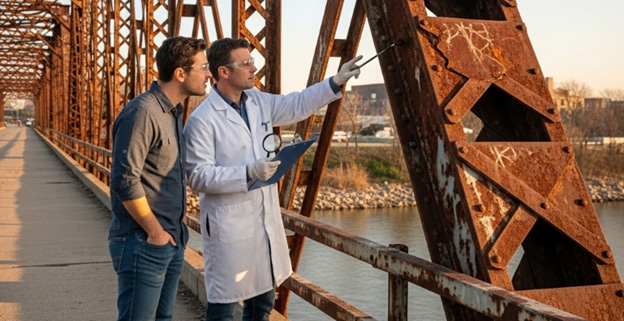
GPI Laboratories story began here, at the Michigan Department of Transportation’s Research Laboratory, where paints and coatings were tested to determine whether they could really keep steel and concrete standing strong through Michigan’s worst conditions. The work was about keeping families safe on the roads, and keeping public money from being wasted on structures that corroded too quickly.
As infrastructure expanded, state DOTs, federal agencies, and manufacturers across the country wanted reliable testing of their coatings, metals, and materials. It became clear that reliable, independent testing was essential—not just within Michigan, but for agencies and manufacturers across the country. To meet that need, GPI Laboratories (originally Corrosion Control Consultants and Laboratories) was founded
For more than 40 years GPI Laboratories has provided reliable testing—not just lab tests, but confidence that bridges, pipelines, ships, factories, and refineries would endure. Our laboratory runs a full range of performance and durability evaluations.
What We Do Today
Coatings Performance Tests (ASTM D4060 Taber Abrasion, D4541 Pull Off Adhesion, D2794 Impact Resistance, D523 Gloss, and More).
Failure analysis and forensic investigations, from FTIR and gas chromatography to microscopic evaluations and service-environment simulations.
Accelerated weathering and corrosion testing, including salt fog (ASTM B117), modified salt fog (ASTM G85), UV/condensation (ASTM G154), cyclic weathering (ASTM D5894/ISO12944), and cathodic disbondment (ASTM G8/G95).
Physical property and product characterization for density, viscosity, pot life, solids contents, volatile organic compounds (EPA Method 24 VOCs), and heavy metals.
Abrasive and surface cleanliness evaluations to SSPC and ISO standards.
Specialty automotive and structural tests, such as the SAE J400 gravelometer and slip coefficient testing for bolted structural connections.
We also prepare and coat panels for customers. And when coatings fail, we help attorneys, agencies, and manufacturers uncover the “why,” often in the context of safety investigations or contract disputes.
Through all of this, one thing hasn’t changed: corrosion never sleeps, and neither does the need for trusted testing. At GPI Laboratories, we remain committed to the same principle that we were founded on: delivering clear, reliable answers so that steel, concrete, and coatings can stand the test of time.
Through all of this, one thing hasn’t changed: corrosion never sleeps, and neither does the need for trusted testing. At GPI Laboratories, we remain committed to the same principle that we were founded on: delivering clear, reliable answers so that steel, concrete, and coatings can stand the test of time.

Contact Us
Fill out the form below, and we will be in touch shortly.
We help governments protect their infrastructure and manufacturers safeguard their products. Whether it’s a bridge designed to carry millions of vehicles, a refinery coating system meant to resist harsh chemicals, or a supplier building parts for the next generation of transportation, our role is the same: to prove durability before the real world has the chance to expose weakness.
At the end of the day, we protect your product, your reputation, and your bottom line with unmatched quality, flexibility, and expertise.