
ASTM G85 TESTING SERVICES
GPI Labs provides ASTM G85 modified salt spray testing services for protective coatings, plated finishes, conversion coatings, metallic materials, fasteners, components, test panels, and finished products. Our independent materials testing laboratory supports all five ASTM G85 annex profiles: A1 acetic acid salt fog, A2 cyclic acidified salt fog, A3 SWAAT, A4 salt/SO2 spray, and A5 Prohesion.
Programs can include specimen preparation, controlled coating application, masking, scribing, exposure, scheduled inspections, post-test evaluation, photography, and reporting. GPI Labs confirms the applicable annex, standard revision, exposure duration, specimen requirements, evaluation method, and acceptance criteria before testing begins.
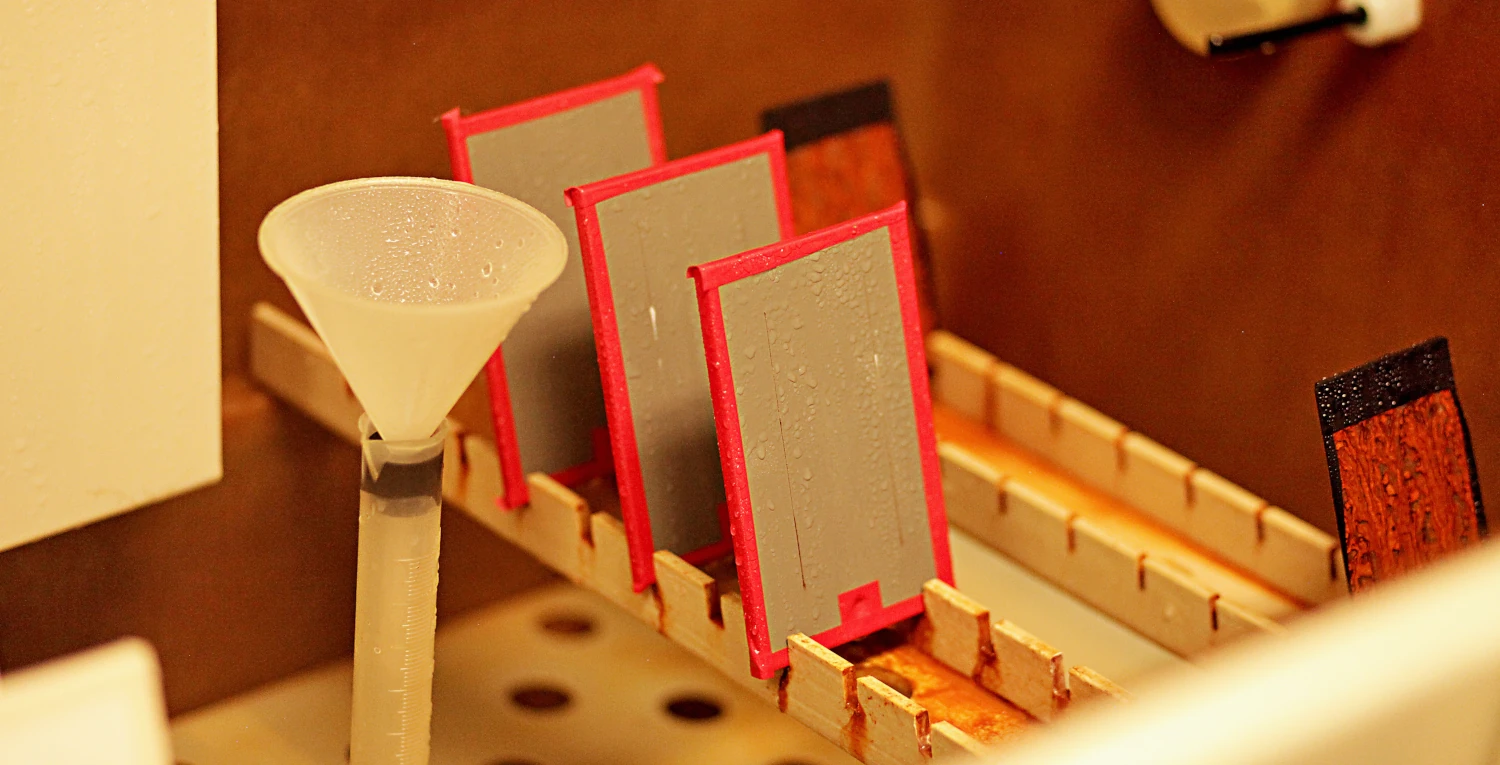
Taped coating specimens positioned inside a GPI Labs corrosion chamber for a controlled salt-fog exposure program.
Send the G85 annex and revision, specimen quantity and dimensions, exposure duration, evaluation requirements, and requested completion date.
What Is ASTM G85 Modified Salt Spray Testing?
ASTM G85 is the Standard Practice for Modified Salt Spray (Fog) Testing. It contains five annexes that modify the chemistry, temperature, humidity, gas exposure, or environmental sequence used in a conventional salt-fog chamber.
The annexes are not interchangeable. A1 uses a continuous acetic-acidified sodium chloride fog. A2 adds repeating spray, purge, and high-humidity soak phases. A3 uses acidified synthetic sea salt in the cyclic SWAAT profile. A4 introduces sulfur dioxide into a salt-fog environment. A5 alternates a dilute sodium chloride/ammonium sulfate fog with a heated dry-off period.
ASTM G85 does not establish one universal pass/fail requirement
The practice defines the exposure apparatus and annex conditions. Your product, material, procurement, or project specification—or the test plan agreed before testing—must establish the applicable annex, exposure time, inspections, evaluation method, and acceptance criteria.
How ASTM G85 differs from ASTM B117
ASTM B117 creates a continuous neutral salt-fog environment. ASTM G85 changes that baseline through acidification, synthetic sea salt, sulfur dioxide, dilute electrolyte, or cyclic changes in spray, purge, humidity, and drying. A G85 profile should be selected because it is required by the governing specification or because its defined environment supports the project objective—not simply because it appears more aggressive than neutral salt spray.
If your requirement calls for continuous neutral salt fog, see GPI Labs’ ASTM B117 salt spray testing services.
What the results can—and cannot—tell you
ASTM G85 testing can compare materials or coating systems, support product qualification, document compliance with a defined requirement, screen formulations, investigate process changes, and provide independent verification. Results are specific to the selected profile, specimens, duration, and evaluation method. Chamber hours should not be converted directly into a specific number of years in field service without appropriate supporting field data.
Looking for another coating, corrosion, weathering, or analytical method? Visit the GPI Labs materials testing services overview.
ASTM G85 A1-A5 Test Profiles
GPI Labs supports each ASTM G85 annex. Because the profiles use materially different environments, the annex designation and governing product specification must be confirmed before the program is scheduled.
| Profile | Exposure | Key Conditions | Common Reasons for Use |
|---|---|---|---|
| A1 Acetic Acid Salt Spray |
Continuous acidified sodium chloride fog | 35 ± 2°C exposure zone; solution pH 3.1-3.3 | Comparative evaluation and quality control of metallic and plated finishes, including decorative chromium systems |
| A2 Cyclic Acidified Salt Fog |
45 min spray, 2 h dry-air purge, 3 h 15 min high-humidity soak | 49 ± 2°C exposure zone; acidified sodium chloride solution at pH 2.8-3.0 | Materials and finishes requiring a high-temperature acidified cycle with distinct wet, purge, and soak phases |
| A3 SWAAT |
30 min spray followed by 90 min soak above 98% RH | Acidified synthetic sea salt at pH 2.8-3.0; exposure temperature defined for the material or product | Aluminum alloys, heat-treatment studies, organic coatings, and requirements specifying seawater acidified testing |
| A4 Salt/SO2 Spray |
Salt fog with periodic sulfur-dioxide introduction | 35 ± 2°C exposure zone; collected solution pH 2.5-3.2; cycle defined by the governing specification or agreement | Coatings and metals exposed to salt-bearing industrial atmospheres containing sulfur dioxide |
| A5 Prohesion |
1 h fog followed by 1 h dry-off | 0.05% sodium chloride + 0.35% ammonium sulfate; ambient fog; dry-off at 35 ± 1.5°C | Paints and protective coating systems—particularly coatings on steel—requiring dilute-electrolyte wet/dry cycling |
ASTM G85 A4 allows solution flexibility
Annex A4 does not prescribe one universal salt solution. The product specification or agreement for the program defines sodium chloride, synthetic sea salt, or another permitted solution and establishes the cycle to be run. Sulfur dioxide dosing is a separate defining feature of the A4 exposure.
Important A3 temperature selection
ASTM G85 A3 permits the exposure-zone temperature to vary with the material being tested. The governing material or product specification should define the temperature, or it must be mutually agreed. The practice recommends 49°C for certain aluminum heat-treatment studies and notes that 24-35°C may be used for organic coatings on metallic substrates because temperatures above 35°C can promote paint blistering.
Why A5 requires a different environmental transition
Prohesion does not simply alternate between “spray on” and “spray off.” The one-hour fog phase occurs at controlled ambient conditions without chamber heating, while the dry phase must remove visible moisture and bring the exposure zone to 35 ± 1.5°C within 45 minutes. The atomizing air is not humidified. GPI Labs assigns the work to a system configured to create and document those required fog-to-dry transitions.
Who Uses ASTM G85 Testing?
ASTM G85 testing is valuable when a coating, finish, material, or product requirement calls for a modified salt-fog environment rather than continuous neutral salt spray. GPI Labs works with manufacturers, formulators, owners, engineers, suppliers, and third-party evaluators across industrial markets.
Aerospace and Defense
Aluminum alloys, conversion coatings, plated hardware, fasteners, protective finishes, and components tested to specification-driven acidified or cyclic salt-fog requirements.
Marine, Offshore, and Energy
Protective coatings, metallic materials, equipment, fasteners, and assemblies evaluated under salt-bearing, synthetic-seawater, wet/dry, or industrial-atmosphere profiles.
Infrastructure and Construction Products
Coated structural products, architectural finishes, building hardware, fabricated metals, electrical enclosures, and outdoor equipment.
Paint, Coatings, and Metal Finishing
Liquid and powder coatings, primers, plated finishes, conversion coatings, pretreatments, and formulation or process comparisons.
Electronics and Electrical Equipment
Connectors, terminals, enclosures, housings, controls, hardware, and assemblies when a G85 annex is part of the applicable requirement.
Fasteners and Industrial Products
Screws, bolts, clips, stampings, machined parts, castings, industrial equipment, and coated or plated production components.
Programs GPI Labs can support
- New coating or finish qualification.
- Independent verification of internal or supplier test results.
- Supplier approval and production-process validation.
- Comparative evaluation of formulations, pretreatments, suppliers, or application variables.
- Quality-control and batch-comparison programs.
- Investigation of unexpected corrosion, blistering, adhesion loss, or coating breakdown.
- Specification, procurement, or customer-submittal testing.
Not sure whether G85 is the right method?
Send GPI Labs the product specification, drawing note, coating system, service environment, or performance question. We can review the requirement and help identify whether the program calls for ASTM G85, ASTM B117, ISO 9227, cyclic corrosion, humidity, condensation, immersion, weathering, gas corrosion, or another defined method.
How GPI Labs Runs an ASTM G85 Test Program
Each program is built around the selected annex and the governing product or project requirement. GPI Labs confirms the specimens, preparation, exposure, inspections, evaluation, and reporting scope before chamber testing begins.
1. We review the governing requirement
GPI Labs confirms the ASTM G85 edition and annex, product or material specification, specimen identification and quantity, test duration, inspection schedule, post-exposure handling, evaluation methods, acceptance criteria, photography, and reporting requirements. For A3 and A4, the program must also establish the temperature, solution, and cycle details left to the governing specification or customer agreement.
2. We define specimen preparation and loading
The project scope establishes whether specimens arrive test-ready or whether GPI Labs will perform substrate preparation, coating application, masking, edge protection, scribing, dry-film-thickness measurement, or other preparation. Orientation, supports, special fixtures, areas of interest, and intermediate removal requirements are documented before loading.
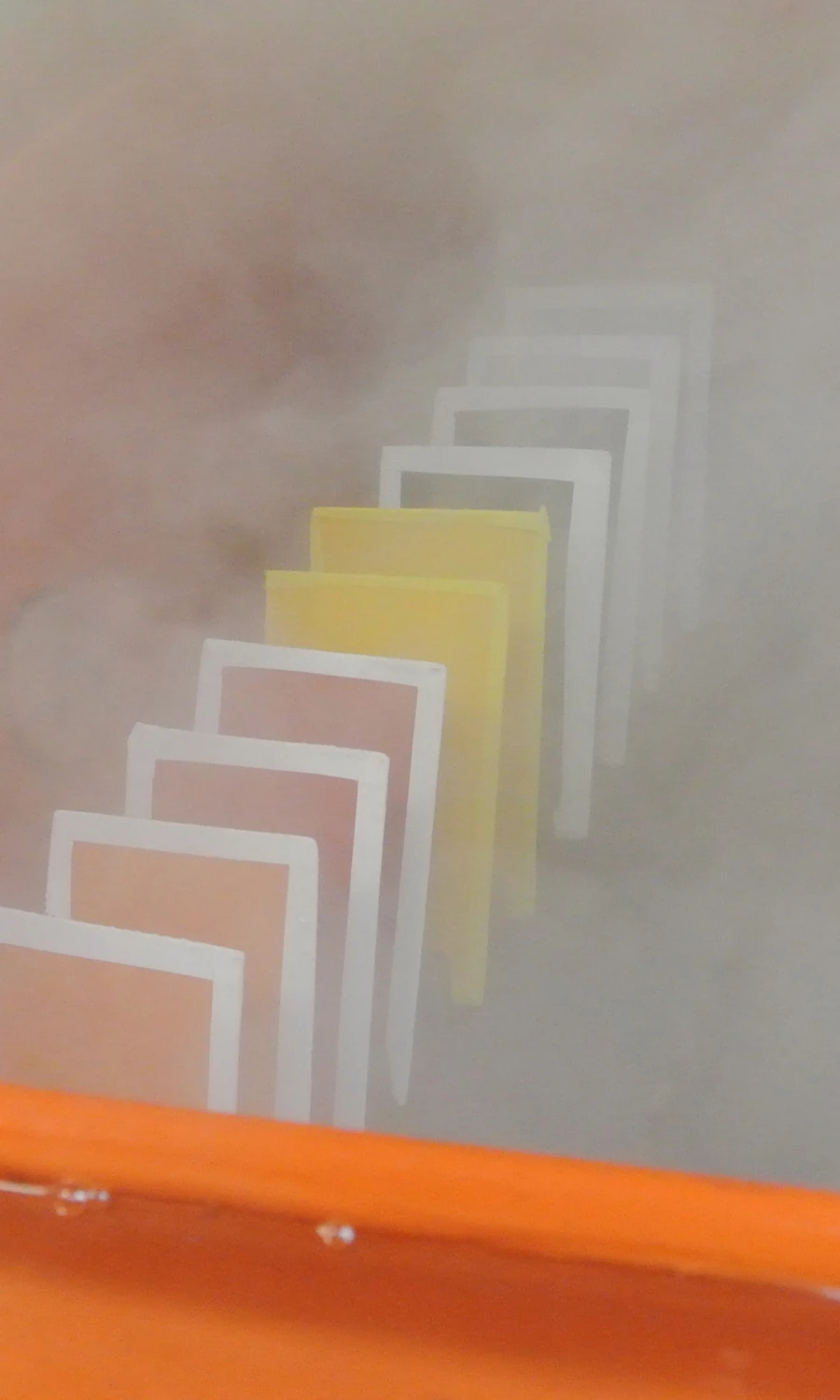
Coated panels exposed to a controlled salt fog inside a water-jacketed corrosion chamber at GPI Labs.
3. We establish and monitor the selected G85 environment
The laboratory prepares the specified electrolyte, configures the chamber for the selected annex, verifies the required temperature and environmental sequence, monitors operating conditions, and documents applicable fog-collection, pH, concentration, cycle, and interruption data. The controls that matter vary by annex; an A1 continuous acidified fog is not monitored as though it were an A5 fog/dry cycle or an A4 sulfur-dioxide exposure.
| Control Area | Why It Matters | Examples |
|---|---|---|
| Electrolyte | The chemistry distinguishes several G85 profiles | Acidified sodium chloride, acidified synthetic sea salt, or dilute sodium chloride/ammonium sulfate |
| pH | The required range differs by annex | A1: 3.1-3.3; A2/A3: 2.8-3.0; A4 collected solution: 2.5-3.2; A5 collected solution: 5.0-5.4 |
| Exposure temperature | Temperature affects corrosion and coating response | 35°C for A1 and A4, 49°C for A2, material-dependent for A3, ambient fog and 35°C dry-off for A5 |
| Environmental sequence | Cyclic profiles require correct phase order and timing | A2 spray/purge/soak, A3 spray/soak, A4 specified salt/SO2 cycle, A5 fog/dry |
| Specimen exposure | Position and runoff can influence results | Defined orientation, unobstructed fog, separation between specimens, and no dripping from one specimen onto another |
| Documentation | Traceable conditions support meaningful interpretation | Start and stop times, readings, inspections, interruptions, deviations, photographs, and requested evaluations |
4. We complete the specified inspections and closeout
At scheduled inspection points or after the final exposure, specimens are handled according to the governing procedure. GPI Labs then performs the agreed visual examination, photography, cleaning, scribe measurement, adhesion testing, coating removal, mass measurement, or other evaluation. Results are compared with acceptance criteria only when those criteria are part of the project scope.
ASTM G85 Specimens and Sample Preparation
GPI Labs can expose production parts, fabricated components, coated test panels, plated specimens, fasteners, and other test articles. Customers may supply test-ready specimens or request a broader program that includes preparation and coating application.
Send test-ready specimens
Provide specimen identification, the governing requirement, exposure duration, orientation, areas to be evaluated, inspection schedule, evaluation method, and acceptance criteria. Include material, pretreatment, plating, coating, cure, and lot information when relevant.
Use GPI Labs preparation capabilities
GPI Labs can source or fabricate substrates, perform abrasive preparation, apply coatings, document dry-film thickness, mask defined areas, protect edges, create controlled scribes, and prepare matched specimen sets for comparison or qualification work.
Specimen details that affect the program
- Cleaning: The method must suit the surface and contaminants without changing the material or coating being evaluated.
- Coating application: Application method, number of coats, recoat interval, cure, conditioning, and dry-film thickness should be controlled and documented.
- Scribing: A scribe is used only when the program is intended to evaluate corrosion development from an intentional coating defect. The scribe tool, geometry, and evaluation method must be defined.
- Edges and identification: Cut edges, identification areas, and rack-contact points are protected when required so they do not become unintended corrosion initiation sites.
- Orientation: Unless otherwise specified, G85 specimens are supported between 6° and 45° from vertical, with the primary surface parallel to the principal direction of fog flow.
- Loading: Specimens must remain separated, receive unobstructed exposure, and be arranged so solution cannot drip from one specimen onto another.
- Intermediate inspections: Removing or disturbing specimens can affect exposure. Inspection timing and handling should be established before the test begins.
Matched panels improve comparative work
When a program compares formulations, pretreatments, suppliers, coating thicknesses, or application variables, GPI Labs can help design matched specimen sets so uncontrolled differences do not overwhelm the comparison.
Post-Exposure Evaluation and ASTM G85 Reporting
ASTM G85 does not supply one rating system or acceptance limit for every material and product. The governing specification or agreed test plan determines what GPI Labs evaluates and what constitutes acceptable performance.
Available evaluations
- Baseline, progress, and final photographs.
- Visual observations at defined inspection points.
- Time to first corrosion or other specified change.
- Rusting, blistering, cracking, flaking, and related coating ratings.
- Scribe creep, underfilm corrosion, or delamination measurements.
- Coating adhesion before or after exposure.
- Mass change or corrosion-product removal when specified.
- Customer-defined observations and acceptance criteria.
Typical report content
- Customer, project, laboratory, and specimen identification.
- Referenced ASTM G85 edition, annex, and governing product or project specification.
- Specimen quantity, material, finish, coating system, dimensions, and relevant preparation.
- Exposure duration, cycle, temperature, solution, pH, and other annex-specific conditions.
- Start and completion dates and applicable chamber or test details.
- Requested setup, progress, and final photographs.
- Post-exposure handling and evaluation methods.
- Inspection observations, measurements, ratings, and requested disposition.
- Applicable interruptions, limitations, or approved deviations.
Information needed for an ASTM G85 quote
- The ASTM G85 annex and revision and any governing product, material, customer, or procurement specification.
- Requested exposure duration and intermediate inspection schedule.
- Specimen material, finish or coating system, quantity, dimensions, and weight.
- Whether specimens will arrive test-ready or require fabrication, preparation, coating, masking, edge protection, or scribing.
- Required orientation, support, electrical or functional state, and special fixtures.
- Required evaluations, rating methods, acceptance criteria, photographs, and reporting format.
- Target start date, required completion date, confidentiality, witness, and return-shipping requirements.
Why Choose GPI Labs for ASTM G85 Testing?
GPI Labs approaches ASTM G85 as part of a broader materials and coatings evaluation—not as isolated chamber time. That matters when specimen preparation, coating variables, post-exposure ratings, or an unexpected result requires closer technical review.
Preparation through reporting
Substrate preparation, coating application, specimen documentation, modified salt-fog exposure, post-test evaluation, photography, and final reporting can remain within one coordinated laboratory program.
More than corrosion exposure
Related capabilities include adhesion, dry-film thickness, physical coatings testing, accelerated weathering, immersion, cathodic disbondment, microscopy, analytical characterization, and failure investigation.
Industrial coating experience
GPI Labs works with protective paint manufacturers, applicators, fabricators, owners, engineers, suppliers, and product manufacturers on qualification, comparison, quality-control, and investigation programs.
A plan matched to the question
The laboratory confirms the annex, specimens, conditions, inspections, evaluations, and reporting before exposure so the resulting data addresses the actual specification or technical objective.
Explore GPI Labs’ broader materials, coatings, corrosion, analytical, and failure-investigation services.
ASTM G85 Testing FAQ
What are the five ASTM G85 test profiles?
ASTM G85 includes A1 acetic acid salt spray, A2 cyclic acidified salt fog, A3 acidified synthetic seawater testing or SWAAT, A4 salt/SO2 spray, and A5 dilute-electrolyte cyclic fog/dry testing commonly called Prohesion.
Can GPI Labs run all ASTM G85 annexes?
Yes. GPI Labs supports laboratory testing across ASTM G85 Annexes A1 through A5. The requested annex and governing specification determine the required chemistry, chamber configuration, temperature, cycle, inspections, and evaluation.
What is the difference between ASTM G85 and ASTM B117?
ASTM B117 creates a continuous neutral salt-fog exposure. ASTM G85 provides modified profiles using acidified chemistry, synthetic sea salt, sulfur dioxide, dilute electrolyte, and cyclic spray, purge, humidity, or drying phases. Use the method required by the governing specification or appropriate to the defined test objective.
What is ASTM G85 A5 Prohesion testing?
A5 alternates one hour of ambient fog with one hour of heated dry-off. The dilute electrolyte contains 0.05% sodium chloride and 0.35% ammonium sulfate by mass. The dry phase must remove visible moisture and reach 35 ± 1.5°C within 45 minutes.
Does ASTM G85 define the test duration and passing result?
No universal duration or acceptance limit applies to every product. The governing product, material, procurement, or customer specification—or the agreed test plan—must define exposure time, evaluation, and acceptance criteria.
Can GPI Labs prepare and coat test panels?
Yes. GPI Labs can source or fabricate substrates, perform abrasive preparation, apply coatings, measure dry-film thickness, mask and protect defined areas, create controlled scribes, and prepare matched panel sets. Customers may also submit test-ready panels or production parts.
Can GPI Labs evaluate specimens after G85 exposure?
Yes. Depending on the governing requirement, evaluations can include photography, visual observations, corrosion and blister ratings, scribe creep or delamination measurements, adhesion testing, mass change, and customer-defined acceptance criteria.
Can ASTM G85 hours be converted into years of service life?
Not from G85 results alone. The test can support comparison and qualification under a defined accelerated environment, but direct service-life predictions require suitable field data and a demonstrated relationship for the specific material system and environment.
Request an ASTM G85 Testing Quote
Tell GPI Labs what you are testing, which ASTM G85 annex and revision apply, how long the exposure must run, and how the specimens must be evaluated. We can quote testing for specimens you supply or a broader program that includes substrate preparation, coating application, masking, scribing, controlled exposure, post-test evaluation, photography, and reporting.