
ASTM D5894 CYCLIC SALT FOG AND UV TESTING SERVICES
GPI Labs performs ASTM D5894 testing for painted metal and protective coating systems using alternating fluorescent UV/condensation and dilute-electrolyte fog/dry exposures. Programs can include test-panel preparation, controlled coating application, specimen scribing, scheduled transfers, corrosion and coating ratings, instrumental appearance measurements, post-exposure adhesion testing, photographic documentation, and reporting to ASTM D5894 or a governing AMPP, SSPC, AASHTO, DOT, federal, or customer specification.
Manufacturers can send identified, test-ready panels or ask GPI Labs to source substrates, prepare surfaces, apply the coating system, measure dry-film thickness, protect edges and backs, and make the required scribe. GPI runs the exposure, records the cabinet conditions and transfers, evaluates the specimens, and reports the measurements. The manufacturer, customer, or approval authority makes the final product-acceptance decision.
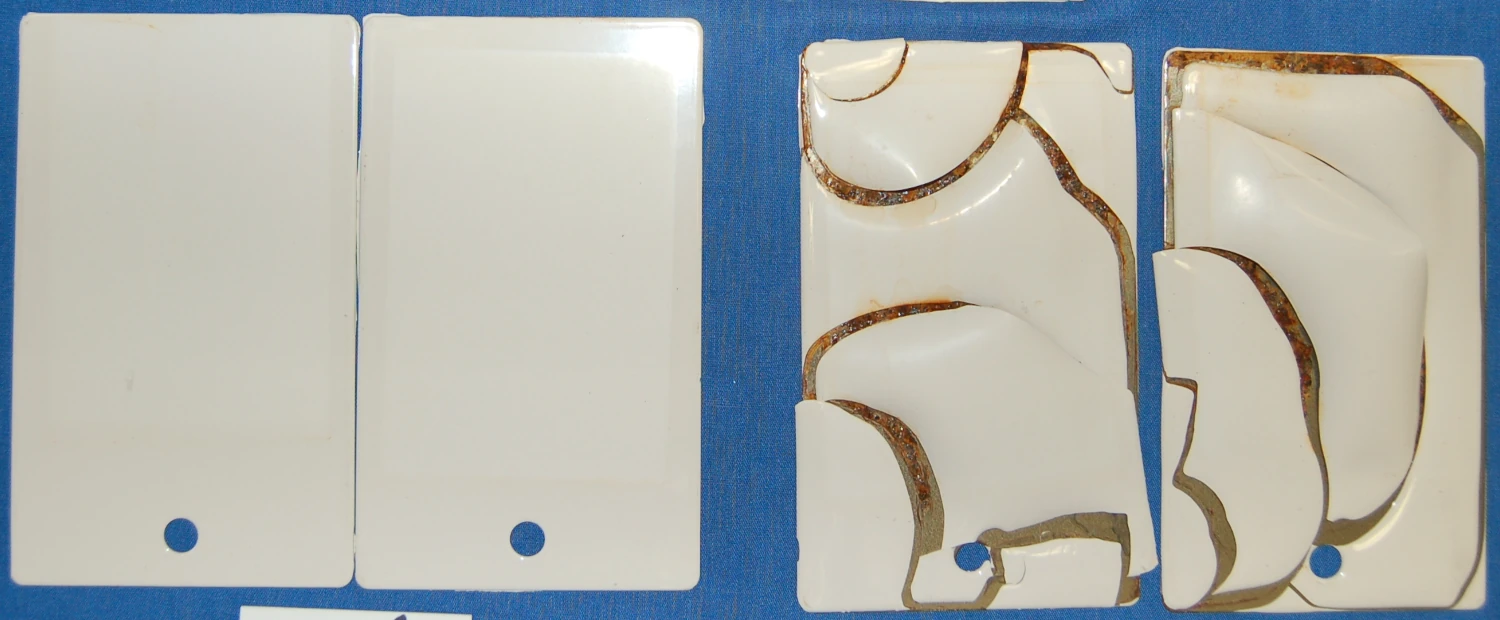
White-coated test panels after 1,000 hours of accelerated UV exposure, showing intact reference panels alongside severe coating lifting, peeling, and delamination with exposed corroded substrate.
Send the applicable ASTM edition or product specification, exposure duration, panel quantity and dimensions, preparation needs, evaluation criteria, and requested completion date. If the requirement is incomplete, GPI Labs can review it with you.
What ASTM D5894 Evaluates
Outdoor deterioration of painted metal is influenced by sunlight, condensed moisture, airborne salts, temperature changes, and repeated wetting and drying. ASTM D5894 combines those stresses in a defined laboratory sequence. Specimens alternate between a fluorescent UV/condensation cabinet and a separate cyclic fog/dry cabinet rather than remaining in one steady-state environment.
The method is especially useful for comparative evaluation of industrial maintenance coatings on steel, including zinc-rich primers. It can reveal differences in rusting, blistering, coating breakdown, scribe creepage, gloss, color, adhesion retention, and other properties selected by the governing specification.
ASTM D5894 defines exposure conditions but does not, by itself, define specimen preparation, acceptance limits, or a universal pass/fail requirement. Those details must come from the product specification, procurement document, customer protocol, or an agreed test plan.
Important limitation: ASTM D5894 does not establish a universal conversion from laboratory hours to years of outdoor service. It is best used for side-by-side comparisons with simultaneously exposed controls or with acceptance criteria established by the governing product specification.
The ASTM D5894 Exposure Cycle
The standard sequence begins in the fluorescent UV/condensation cabinet. After one week, specimens move to the fog/dry cabinet for one week. Together, the two exposures form one 336-hour cycle.

Fluorescent UV and Condensation
ASTM D4587 Cycle 2 and ASTM G154
- UVA-340 fluorescent lamps.
- 4 hours UV at 60 °C black-panel temperature.
- Target irradiance of 0.89 W/(m²·nm) at 340 nm.
- 4 hours condensation at 50 °C black-panel temperature.
- 21 eight-hour UV/condensation cycles.
The initial UV and condensation exposure can damage or weather the coating before the specimens encounter the corrosive electrolyte.
Coated test panels after laboratory UV weathering exposure, showing visible discoloration and surface change following exposure to ultraviolet radiation, heat, and moisture. Fluorescent-UV weathering of coatings is commonly performed under ASTM G154 and ISO 16474-3.

Dilute Electrolyte Fog and Dry-Off
ASTM G85 Annex A5
- 1 hour fog at ambient temperature.
- 1 hour dry-off at 35 °C chamber-air temperature.
- 0.05% sodium chloride by mass.
- 0.35% ammonium sulfate by mass.
- 84 two-hour fog/dry cycles.
Positive dry-off is essential. If laboratory ambient temperature exceeds 30 °C, the dry-off set point is raised as required by ASTM D5894.
Fiberglass cyclic corrosion chambers capable of running the ASTM G85 Annex A5 fog/dry exposure used during the corrosion half of ASTM D5894.
Transfer, Reposition, and Repeat
One complete cycle equals 336 hours
- Specimens are repositioned during cabinet transfers to reduce location bias.
- Specimens are not washed or cleaned between exposures unless otherwise agreed.
- Standard evaluations occur after complete two-step cycles and at test completion.
- Controls and at least three replicate specimens are recommended.
- If no duration is otherwise established, ASTM D5894 identifies 1,008 hours as a default option.
Many coating specifications establish their own longer durations, inspection intervals, replicate counts, ratings, and acceptance criteria.

ASTM D5894 Testing at GPI Labs
GPI can run the specified exposure on customer-supplied panels or prepare, coat, scribe, expose, and evaluate the specimens. The test plan identifies the panel construction, coating application, exposure duration, inspection schedule, measurements, and reporting requirements.
1. Confirm the Test Requirements
GPI reviews the requested ASTM edition, product or project specification, exposure duration, specimen count, panel construction, scribe geometry, control materials, inspection intervals, evaluation methods, acceptance criteria, and reporting needs. This step is important because ASTM D5894 does not supply every requirement needed for product qualification.
2. Prepare Panels and Apply the Coating System
When requested, GPI can source substrates, fabricate test panels, prepare surfaces, apply primers and complete multi-coat systems, control wet- and dry-film thickness, observe recoat and cure intervals, seal backs and edges, add identification, and make the specified scribe. Customer-prepared specimens can also be tested as received.
3. Run and Document the Alternating Exposure
GPI documents the UV/condensation and corrosion cabinets used, lamp and black-panel information, exposure settings, electrolyte formulation, dates, cycle count, transfers, repositioning, interruptions, and deviations. Specimens can be photographed and evaluated at agreed checkpoints without being washed between exposures.
4. Evaluate Coating and Corrosion Performance
The final evaluation is selected from the governing specification and may include rusting, blistering, scribe creepage or coating loss, visual defects, gloss, color change, dry-film thickness, tape or pull-off adhesion, and microscopy or cross-sectional examination. GPI reports the actual method used for each result.
5. Report the Exposure and Measurements
Reports identify the test and control specimens, governing documents and editions, exposure conditions, duration and cycle count, evaluation methods, individual and summarized results, photographs, and deviations. When the manufacturer supplies numerical acceptance criteria, GPI can organize the measurements against those limits. The manufacturer, customer, or approval authority makes the final product-acceptance decision.
ASTM D5894 Evaluation and Reporting
GPI documents the variables needed to reconstruct the exposure and understand the condition of each panel. Additional measurements are included when required by the product specification or test plan.
Project and Exposure Record
- Project, coating system, panel, and control identification.
- Governing standard, specification, edition, and cycle definition.
- Start and end date, total exposure, number of cycles, and transfer record.
- Required inspection and evaluation intervals.
- Interruptions, agreed variations, and method deviations.
Corrosion Cabinet Record
- Fog/dry cabinet identification.
- Electrolyte composition and preparation record.
- Fog and dry-off cycle conditions.
- Ambient-temperature considerations and positive dry-off.
- Specimen placement, transfer, and repositioning.
UV Cabinet Record
- UV/condensation cabinet identification.
- Light source, lamp type, lamp age, and replacement during testing.
- Irradiance control and test cycle used.
- Black-panel sensor type and temperature.
- Specimen position or distance as required by the apparatus and method.
Specimen Evaluation
- Blistering ratings under ASTM D714.
- Rust ratings under ASTM D610 or SSPC-VIS 2 when specified.
- Scribe creepage or coating loss under ASTM D1654 or SSPC-PA 16.
- Visual effects, coating defects, and photographic documentation.
- Gloss, color, film thickness, and adhesion before or after exposure when required.
Products and Industries Served
GPI performs ASTM D5894 exposure and evaluation for coating manufacturers, owners, agencies, engineers, fabricators, and applicators. Coatings can be tested against a product specification, compared with a control system, or evaluated during formulation development.
Products and Coating Systems Tested
- Zinc-rich and zinc-pigmented primers.
- Epoxy and epoxy-polyamide protective coatings.
- Moisture-cure polyurethane primers and intermediate coats.
- Latex exterior coatings for structural steel.
- Aluminum-pigmented epoxy coating systems.
- Primer, intermediate-coat, and topcoat systems for bridge steel.
- Industrial maintenance paints and corrosion-control systems.
- Customer-developed formulations and competitive coating systems.
Industries and Testing Programs
- Paint, coating, resin, pigment, and raw-material manufacturers.
- Bridge owners, state DOTs, transportation agencies, and rail infrastructure.
- Structural steel fabricators and coating applicators.
- Industrial plants, utilities, tanks, facilities, and process equipment.
- Marine, coastal, and other salt-exposed infrastructure.
- OEM and manufactured-product development teams.
- Engineering firms, specifiers, consultants, and independent product evaluators.
- Federal, state, and regional coating qualification programs.
ASTM D5894 Testing FAQ
Is ASTM D5894 the same as ASTM G85 Annex A5?
No. ASTM G85 Annex A5 supplies the dilute-electrolyte fog/dry exposure used during the corrosion half of ASTM D5894. ASTM D5894 adds a separate week of fluorescent UV/condensation exposure under ASTM D4587 and ASTM G154, followed by transfer back to the fog/dry cabinet.
Is ASTM D5894 the same as ASTM B117 salt spray?
No. ASTM B117 is a continuous neutral salt-fog practice. ASTM D5894 alternates UV/condensation weathering with an ASTM G85 Annex A5 fog/dry cycle using a dilute sodium-chloride and ammonium-sulfate electrolyte.
How long does ASTM D5894 testing take?
One complete ASTM D5894 cycle takes 336 hours, or two weeks. ASTM D5894 identifies 1,008 hours as an option when no other duration is available, but product and agency specifications commonly require approximately 1,500 to 5,040 hours. The governing specification determines the actual duration.
What evaluations are included?
ASTM D5894 identifies ASTM D610, ASTM D714, and ASTM D1654 as useful corrosion and coating evaluation methods, but the governing specification controls the required ratings and acceptance criteria. GPI can also measure gloss, color, film thickness, and adhesion when included in the test plan.
Does GPI decide whether the coating passes?
GPI runs the exposure, measures and documents the specimen condition, and can organize the results against stated criteria. The coating manufacturer, customer, agency, or other approval authority makes the final product-acceptance decision.
Can GPI prepare and coat the test panels?
Yes. GPI can source and fabricate substrates, prepare surfaces, apply single- or multi-coat systems, control film thickness, observe cure and recoat intervals, seal backs and edges, scribe panels, identify specimens, and prepare matched control panels according to the governing requirements.
Can ASTM D5894 results be converted to years of outdoor service?
Not by a universal conversion factor. The relationship between laboratory exposure and outdoor performance varies by coating, formulation, environment, location, and failure mechanism. ASTM D5894 is strongest as a controlled comparative method using simultaneously exposed specimens and appropriate controls.
Request an ASTM D5894 Testing Quote
Tell GPI Labs what coating system you are evaluating, which ASTM edition or related product specification applies, how long the exposure must run, and how the specimens must be evaluated. We can quote testing for panels you supply or testing that includes substrate preparation, coating application, scribing, alternating UV and corrosion exposure, post-test evaluation, photography, and reporting.